
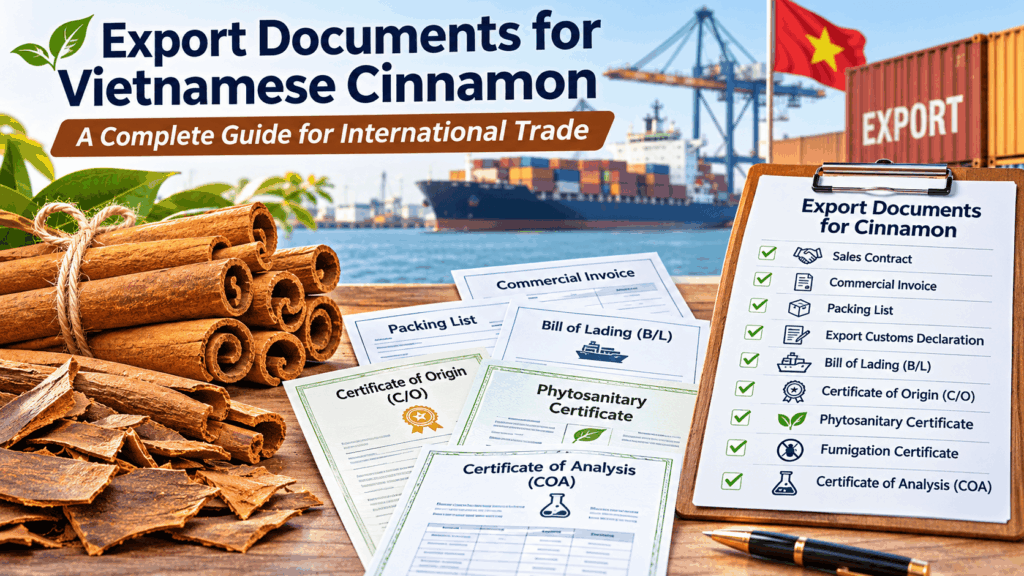
Vietnam is one of the world’s important sources of Cassia cinnamon, supplying international markets with products such as cinnamon sticks, split cassia, broken cinnamon, and cinnamon powder.
For exporters, preparing the correct documentation is an essential part of international trade. A complete and accurate export document set helps facilitate customs clearance, meet import requirements, support payment procedures, and ensure smooth delivery to overseas buyers.
In this guide, TOPAX introduces the main documents commonly required when exporting Vietnamese cinnamon and explains their purposes.
1. Commercial Documents for Cinnamon Export
Commercial documents provide essential information about the transaction, products, prices, quantities, and packaging.
Sales Contract
A Sales Contract is an agreement between the exporter and importer that defines the terms and conditions of the transaction.
It typically includes:
- Seller and buyer information
- Product name and specifications
- Quantity and unit price
- Total contract value
- Packaging requirements
- Delivery terms (Incoterms)
- Payment terms
- Shipment schedule
A clear sales contract helps both parties understand their responsibilities and avoid misunderstandings during the transaction.
Commercial Invoice
The Commercial Invoice is an important document issued by the exporter to the buyer. It provides details of the goods being sold and their commercial value.
For cinnamon shipments, it generally includes:
- Exporter and importer details
- Product description
- Country of origin
- Quantity and unit price
- Total invoice value
- Currency
- Payment and delivery terms
The invoice is commonly used for customs valuation and international payment procedures.
Packing List
The Packing List provides detailed information about how the cinnamon shipment is packed.
It usually includes:
- Product name and grade
- Number of packages
- Net weight and gross weight
- Packaging type
- Dimensions, when applicable
- Shipping marks
For example, Vietnamese Cassia Cinnamon may be packed in 25 kg or 50 kg bags, depending on the buyer’s requirements.
Accurate packing information helps buyers, shipping companies, and customs authorities identify and handle the shipment.
2. Shipping and Customs Documents
Export Customs Declaration
The Export Customs Declaration is submitted to Vietnamese Customs when carrying out export clearance procedures.
The declaration contains information about the exporter, consignee, product description, HS code, quantity, customs value, and other relevant details.
Exporters must ensure that the declared information is consistent with the commercial documents and applicable customs regulations.
Bill of Lading (B/L)
A Bill of Lading is a shipping document issued by the carrier or its agent after receiving the goods for transportation.
For sea freight, it generally serves as:
- Evidence that the carrier has received the goods
- Evidence of the contract of carriage
- A document of title in the case of a negotiable original bill of lading
The B/L contains details such as the shipper, consignee, vessel, loading port, destination port, cargo description, and number of packages.
Certificate of Origin (C/O)
A Certificate of Origin confirms the country in which the exported goods originate.
For Vietnamese cinnamon, the C/O may be requested by the buyer or required to claim preferential import duties under an applicable trade agreement.
The appropriate type of C/O depends on the destination market and the rules of origin applicable to the product.
Exporters should confirm the required C/O form with their buyers before shipment.
3. Phytosanitary and Quality Certificates
Because cinnamon is a plant-based agricultural product, certain markets may require additional certificates to verify plant health, product safety, and quality.
Phytosanitary Certificate
A Phytosanitary Certificate is an official document issued by the competent plant protection authority after the required inspection.
It confirms that the consignment meets the applicable phytosanitary requirements of the importing country.
Import requirements vary between markets. Exporters should check the destination country’s regulations before arranging shipment.
Fumigation Certificate
A Fumigation Certificate provides evidence that the cargo or packaging has undergone fumigation treatment.
It may be requested by the buyer, importing authorities, or shipping-related requirements.
Whether fumigation is necessary depends on the destination country’s regulations, the type of goods and packaging, and the buyer’s specifications.
Certificate of Analysis (COA)
A Certificate of Analysis is a laboratory report showing the test results of a product against specified quality parameters.
For Vietnamese Cassia Cinnamon, buyers may request testing for:
- Moisture
- Foreign matter
- Ash content
- Volatile oil content
- Microbiological parameters
- Heavy metals
- Pesticide residues
The required testing parameters depend on the buyer’s specifications and the food safety regulations of the destination market.
Certificate of Quality
A Certificate of Quality confirms that the goods meet the agreed product specifications.
It may cover product grade, appearance, color, aroma, moisture, purity, and other agreed characteristics.
The certificate may be issued by the exporter, manufacturer, or an independent inspection company, depending on the contract.
Other Supporting Documents
Depending on the destination market and buyer’s requirements, additional documents may include:
- Health Certificate
- Certificate of Free Sale (CFS)
- Certificate of Weight
- Insurance Certificate or Policy
These documents are not universally required for every cinnamon shipment. Their necessity should be confirmed before shipment.
4. When Should Exporters Prepare These Documents?
Preparing export documents in the correct order helps reduce delays and avoid inconsistencies.
Before shipment:
- Confirm the sales contract and product specifications.
- Prepare the Commercial Invoice and Packing List.
- Arrange product inspection and laboratory testing if required.
- Apply for the Phytosanitary Certificate when applicable.
- Arrange fumigation if required.
- Confirm the required Certificate of Origin.
During customs clearance:
- Submit the export customs declaration.
- Complete applicable customs procedures.
- Provide supporting documents requested by the relevant authorities.
After shipment:
- Obtain the final Bill of Lading.
- Finalize the export document set.
- Arrange the Insurance Certificate if required under the agreed delivery terms.
- Send the documents to the buyer or bank according to the payment agreement.
5. Important Considerations When Exporting Vietnamese Cinnamon
Before shipping cinnamon internationally, exporters should pay attention to several important points.
Check the importing country’s regulations.
Different countries have different requirements for plant products, food safety, pesticide residues, and phytosanitary controls. Exporters should confirm these requirements before shipment.
Ensure consistency across all documents.
Product names, quantities, weights, packaging details, consignee information, and shipment details should be consistent across the Commercial Invoice, Packing List, Certificate of Origin, and Bill of Lading.
Understand the agreed Incoterms.
Under FOB, CFR, and CIF conditions, the responsibilities of the seller and buyer differ. For example, under CIF, the seller is responsible for arranging ocean freight and the required cargo insurance to the named destination port.
Confirm document requirements with the buyer.
Some buyers may require additional certificates, laboratory reports, or third-party inspection documents. These requirements should be agreed upon before shipment to avoid unexpected costs and delays.
6. Conclusion
Preparing the correct export documents is an essential step in international cinnamon trade. From commercial invoices and packing lists to certificates of origin, phytosanitary certificates, and laboratory reports, each document serves a specific purpose in ensuring a smooth export process.
For Vietnamese cinnamon exporters, understanding both Vietnamese export procedures and the importing country’s requirements is crucial for successful international transactions.
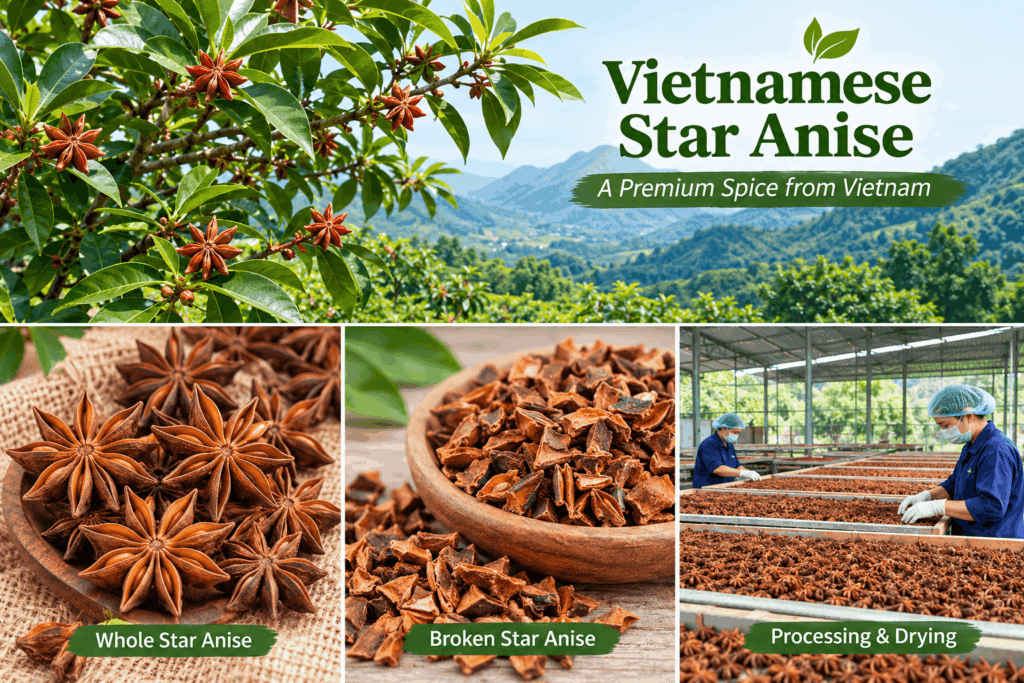
At TOPAX, we specialize in Vietnamese Cassia Cinnamon and other agricultural spices, including Star Anise and Black Pepper. We are committed to supplying international buyers with products that meet agreed specifications and supporting our customers with the necessary export documentation.
For product information and export inquiries, please contact:
TOPAX – Vietnamese Spice Manufacturer & Exporter
Website: https://topax.com.vn/
Email: export@topax.com.vn | info@topax.com.vn
WhatsApp: +84 987 995 271