
Spices have played an important role in human history for thousands of years. From ancient trade routes to modern food manufacturing, spices have been valued for their distinctive flavors, aromas, colors, and versatility. Today, they are essential ingredients in kitchens, restaurants, food processing facilities, and culinary traditions around the world.
Different regions have developed their own preferences for spices, depending on local cuisines, agricultural conditions, and cultural traditions. Some spices are widely used to add heat and flavor, while others provide warmth, fragrance, color, or depth to dishes.
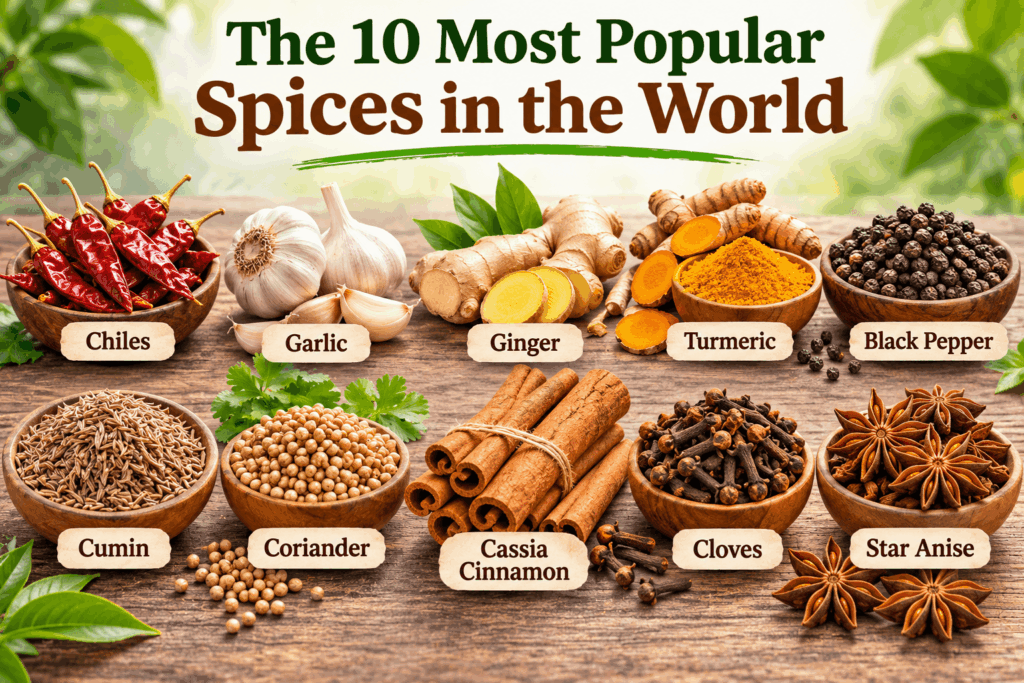
Among the many spices traded internationally, chilies, garlic, ginger, turmeric, black pepper, cumin, coriander, Cassia Cinnamon, cloves, and star anise stand out for their widespread culinary applications and commercial importance.
In this article, we explore the 10 most popular spices in the world, including their origins, distinctive characteristics, common uses, and importance in the global spice industry.
1. Chiles
Chiles, also known as chili peppers, are among the most widely used spices in the world. Originally native to the Americas, chili peppers spread across Asia, Africa, and Europe through international trade and exploration.
Today, they are essential ingredients in many cuisines, particularly in Mexico, India, Thailand, China, Korea, and other countries where spicy food is popular.
Chiles are known for their characteristic heat, which comes from capsaicin, a naturally occurring compound found mainly in the inner tissues and membranes of chili peppers.
There are many varieties of chiles, including cayenne pepper, jalapeño, habanero, bird’s eye chili, and paprika peppers. Each variety has a different level of heat, flavor profile, color, and culinary application.
Common uses of chiles:
- Adding heat to sauces, soups, and marinades.
- Producing chili powder, chili flakes, and seasoning blends.
- Flavoring meat, seafood, and vegetable dishes.
- Manufacturing hot sauces and processed food products.
- Creating spicy seasonings for snacks and packaged foods.
Chiles are available in fresh, dried, crushed, powdered, and processed forms, making them an important commodity in the international spice trade.
2. Garlic
Garlic is one of the most widely recognized culinary ingredients worldwide. Belonging to the Allium family, which also includes onions and shallots, garlic is valued for its strong aroma and distinctive savory flavor.
It has been cultivated and used for thousands of years in different regions, particularly across Asia, the Mediterranean, and the Middle East.
The characteristic smell and flavor of garlic develop when its cells are damaged or crushed, allowing naturally occurring compounds to form, including allicin.
Garlic is extremely versatile and can be used in fresh, dried, powdered, granulated, or oil-infused forms.
Common uses of garlic:
- Seasoning meat, seafood, and vegetable dishes.
- Preparing sauces, marinades, soups, and stews.
- Producing garlic powder and garlic granules.
- Manufacturing spice blends and seasoning products.
- Flavoring snacks, instant foods, and processed products.
Because of its strong flavor and wide culinary applications, garlic remains an important ingredient for households, restaurants, and food manufacturers.
3. Ginger
Ginger is a popular spice obtained from the underground rhizome of the ginger plant, scientifically known as Zingiber officinale.
It is believed to have originated in Southeast Asia and has been used in traditional cooking and food preparation for centuries. Today, ginger is widely consumed throughout Asia, Europe, Africa, and the Americas.
Ginger has a warm, slightly sweet, and pungent flavor with a refreshing aroma. Its distinctive taste comes from natural compounds such as gingerols and shogaols.
Fresh ginger and dried ginger offer different flavor characteristics. Fresh ginger generally has a bright, juicy, and slightly citrus-like taste, while dried ginger tends to have a warmer and more concentrated flavor.
Common uses of ginger:
- Preparing soups, curries, and stir-fried dishes.
- Flavoring tea, beverages, and herbal drinks.
- Producing ginger powder and dried ginger slices.
- Manufacturing confectionery, biscuits, and baked goods.
- Creating sauces, marinades, and seasoning blends.
Ginger is also widely used in the beverage and food processing industries because of its distinctive aroma and versatile flavor profile.
4. Turmeric
Turmeric is a golden-yellow spice obtained from the rhizome of the plant Curcuma longa, which belongs to the ginger family.
It has a long history of cultivation and culinary use in South Asia, particularly in India, where it is an essential ingredient in many traditional dishes.
Turmeric is best known for its bright yellow-orange color, earthy aroma, and slightly bitter, warm flavor. Its main natural coloring compound is curcumin, which gives turmeric its characteristic golden appearance.
Turmeric is available in several forms, including fresh rhizomes, dried fingers, powder, and extracts.
Common uses of turmeric:
- Adding color and flavor to curries and rice dishes.
- Preparing spice blends and seasoning mixtures.
- Manufacturing sauces, soups, and processed foods.
- Producing natural food coloring ingredients.
- Flavoring beverages and selected confectionery products.
Beyond its culinary applications, turmeric is also widely researched for its naturally occurring compounds, particularly curcumin, which has attracted interest in the food, supplement, and personal care industries.
5. Black Pepper
Black Pepper is often called the “King of Spices” because of its widespread use and importance in the international spice trade.
It is obtained from the dried berries of the pepper plant, scientifically known as Piper nigrum. The plant is native to the Malabar Coast of India, but it is now cultivated in several tropical countries, including Vietnam, Indonesia, Brazil, and India.
Black Pepper is recognized for its sharp, pungent flavor and distinctive aroma. Its characteristic heat comes primarily from piperine, a naturally occurring compound found in peppercorns.
Black Pepper is available in several commercial forms, including whole black pepper, ground black pepper, crushed pepper, and pepper powder.
Common uses of Black Pepper:
- Seasoning meat, seafood, vegetables, and soups.
- Flavoring sauces, marinades, and salad dressings.
- Producing spice blends and seasoning powders.
- Manufacturing processed foods and ready-to-eat products.
- Supplying restaurants, food manufacturers, and spice distributors.
Black Pepper is one of the most commercially important spices globally, with strong demand from both retail and industrial food markets.
6. Cumin
Cumin is a popular spice obtained from the dried seeds of the plant Cuminum cyminum. It is widely used in South Asian, Middle Eastern, North African, Latin American, and Mediterranean cuisines.
Cumin seeds have a distinctive warm, earthy, and slightly nutty flavor. Their aroma becomes more pronounced when the seeds are lightly toasted before cooking.
The spice is available as whole cumin seeds, ground cumin powder, and roasted cumin products.
There are also different varieties and related products, including black cumin, which should not be confused with ordinary cumin.
Common uses of cumin:
- Seasoning curries, soups, and stews.
- Preparing traditional spice blends.
- Flavoring meat, poultry, and vegetable dishes.
- Manufacturing sauces and packaged seasonings.
- Producing cumin powder for food processing.
Cumin is particularly important in the international spice market because of its extensive use in traditional cuisines and commercial seasoning formulations.
7. Coriander
Coriander is a versatile spice obtained from the dried seeds of the coriander plant, scientifically known as Coriandrum sativum.
Although the fresh leaves are commonly called cilantro in some countries, coriander seeds are widely used as a spice in their own right.
Coriander seeds have a mild, warm, citrus-like, and slightly sweet aroma. They are commonly used whole or ground, depending on the recipe and intended application.
The seeds are often roasted before grinding to enhance their fragrance and flavor.
Common uses of coriander:
- Preparing curry powders and spice blends.
- Seasoning meat, fish, and vegetable dishes.
- Flavoring soups, sauces, and marinades.
- Producing ground coriander powder.
- Manufacturing pickling spices and processed food products.
Coriander is an important ingredient in many traditional seasoning blends and is frequently combined with cumin, turmeric, chili, and other spices.
8. Cassia Cinnamon
Cassia Cinnamon is one of the most popular and commercially important cinnamon varieties in the global spice industry.
It is obtained from the inner bark of trees belonging to the genus Cinnamomum. Cassia is widely traded and used in food preparation, particularly in Asian cuisines and international food manufacturing.
Compared with Ceylon Cinnamon, Cassia generally has a stronger, more intense, and spicier flavor. Its bark is typically thicker and darker, with a bold aromatic profile that makes it suitable for many culinary applications.
Cassia Cinnamon contains naturally occurring aromatic compounds, particularly cinnamaldehyde, which contributes to its characteristic sweet and spicy fragrance.
Cassia is available in different commercial forms, including cinnamon sticks, split cinnamon, broken cinnamon, ground cinnamon, and cinnamon powder.
Common uses of Cassia Cinnamon:
- Flavoring tea, coffee, and other beverages.
- Preparing curries, soups, and traditional dishes.
- Manufacturing bakery products, biscuits, and confectionery.
- Producing spice blends and seasoning powders.
- Supplying the food processing and essential oil industries.
Cassia Cinnamon is an important raw material in the international spice trade. Its strong aroma, versatile applications, and availability in different product specifications make it a popular choice among spice importers, wholesalers, and food manufacturers.
9. Cloves
Cloves are aromatic flower buds obtained from the clove tree, scientifically known as Syzygium aromaticum.
Native to the Maluku Islands of Indonesia, cloves have been traded internationally for centuries and remain an important ingredient in many culinary traditions.
They are recognized for their strong, warm, sweet, and slightly bitter flavor. Their distinctive aroma is largely associated with eugenol, a naturally occurring aromatic compound found in clove essential oil.
Cloves are commonly available as whole dried buds, ground cloves, and clove oil.
Common uses of cloves:
- Flavoring meat dishes, soups, and sauces.
- Preparing baked goods and traditional desserts.
- Adding aroma to tea and other beverages.
- Producing spice blends and seasoning products.
- Manufacturing fragrance and essential oil products.
Cloves are particularly popular in Asian, Middle Eastern, and European cuisines, where they are used in both sweet and savory recipes.
10. Star Anise
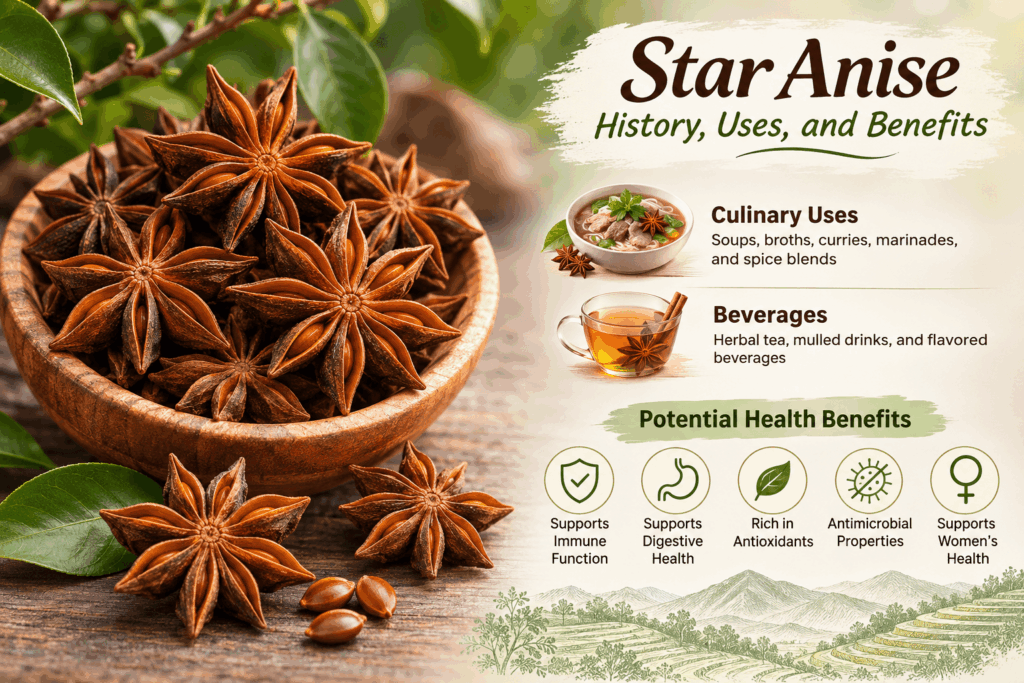
Star Anise is one of the most distinctive aromatic spices in the world. It is obtained from the dried, star-shaped fruit of the evergreen tree Illicium verum.
Native to parts of Asia, Star Anise is widely used in traditional Chinese, Vietnamese, Indian, and other Asian cuisines. It is especially valued for its sweet, warm, and licorice-like aroma.
The main aromatic compound in Star Anise is anethole, which gives the spice its characteristic fragrance and flavor.
Star Anise is commonly available as whole dried pods, broken Star Anise, Star Anise powder, and essential oil.
Common uses of Star Anise:
- Preparing traditional soups, broths, and meat dishes.
- Flavoring spice blends such as Chinese five-spice powder.
- Adding aroma to tea, beverages, and herbal infusions.
- Producing Star Anise powder and essential oil.
- Supplying food manufacturers and spice processing companies.
Whole Star Anise is particularly valued for its attractive star-shaped appearance and strong natural aroma, while Broken Star Anise is commonly used in grinding, extraction, and industrial food processing.
As an important ingredient in the global spice trade, Star Anise continues to attract demand from importers, wholesalers, distributors, and food manufacturers.
Conclusion
Spices are essential ingredients in cuisines and food industries around the world. Each spice has its own distinctive aroma, flavor, color, and culinary applications, contributing to the diversity of global food culture.
From the heat of chiles and the pungent flavor of Black Pepper to the warm fragrance of Cassia Cinnamon and the sweet aroma of Star Anise, these ten popular spices remain important products in international trade.
As consumer interest in diverse flavors and natural food ingredients continues to develop, the global spice industry offers opportunities for growers, processors, exporters, importers, and food manufacturers.
For businesses involved in international spice sourcing, understanding the characteristics, applications, and quality specifications of different spices is essential for selecting suitable products and building reliable supply chains.
TOPAX is committed to connecting international buyers with quality spice products, including Cassia Cinnamon, Star Anise, and Black Pepper. We welcome inquiries from importers, wholesalers, distributors, and food manufacturers looking for reliable bulk spice supply and long-term business partnerships.