
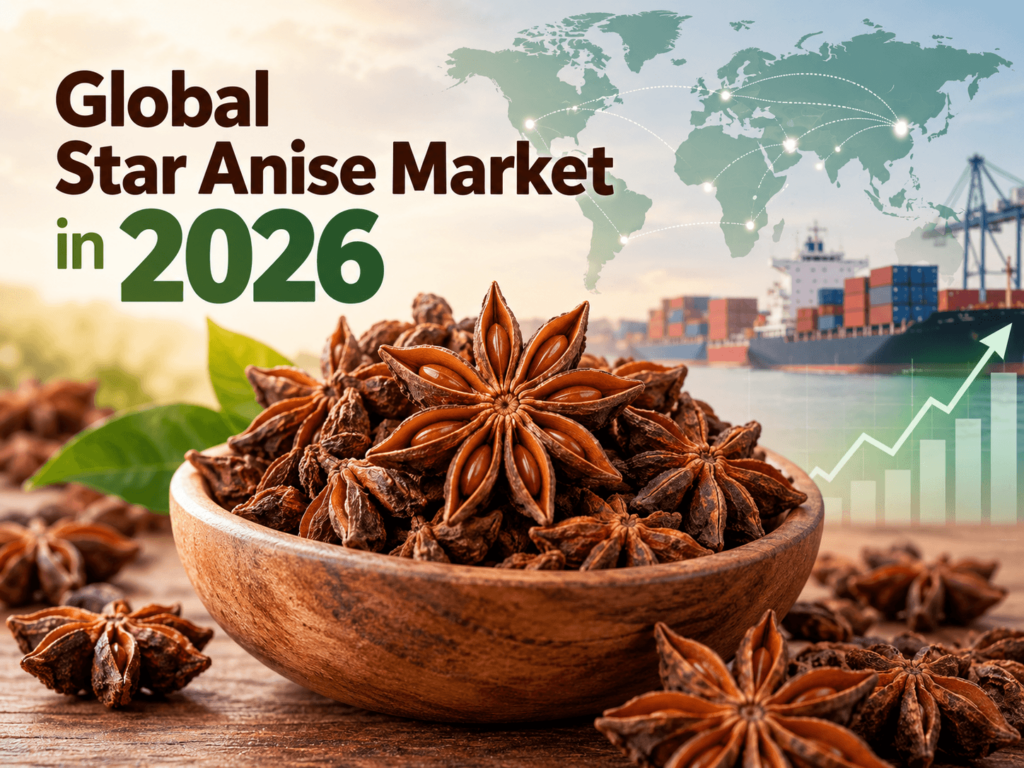
The global star anise market in 2026 is being shaped by fluctuations in supply, import demand, and changes in export market distribution. As a commercially valuable spice, star anise (Illicium verum) is widely used in food processing, spice blends, and certain fragrance-related industries. As international trade increasingly emphasizes product quality and traceability, understanding market trends has become important for importers, distributors, and food processing companies.
Vietnam is currently one of the world’s important star anise suppliers, with major growing areas concentrated in the northern mountainous provinces. However, export data for 2026 indicates that market performance has not been uniform. While total export volumes have declined during certain periods compared with the previous year, some markets outside Asia have recorded notable growth. These developments create both opportunities and challenges for businesses participating in the global star anise supply chain.
Overview of the Global Star Anise Market in 2026
The Role of Star Anise in the Global Spice Market
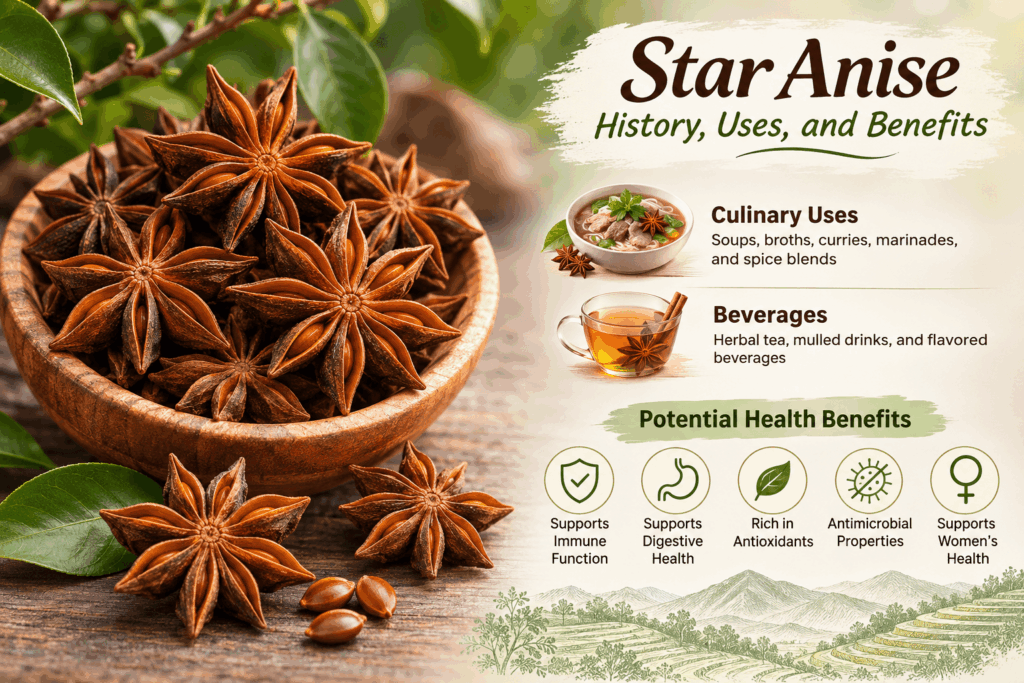
Star anise is a distinctive aromatic spice commonly used in cooking, broths, spice blends, and processed food products. In addition to its use as a dried spice, star anise can serve as a raw material for essential oil extraction and certain other industrial applications.
In international trade, star anise is sold in different product forms, with whole star anise and broken star anise being among the most common. Whole star anise is suitable for applications where the appearance and shape of the spice need to be preserved, while broken star anise can be used in grinding, blending, and other processing applications.
For B2B businesses, the commercial value of star anise depends not only on its selling price but also on product quality, consistency between shipments, supply capacity, and the technical specifications required by each importing market.
Major Star Anise Producing and Supplying Countries
Vietnam and China are two important sources of star anise in the global market. According to information reported by DTiNews, citing the Vietnam Pepper and Spice Association (VPSA) in June 2026, Vietnam has approximately 55,000 hectares of star anise plantations, with estimated annual production of around 22,000 metric tons. Meanwhile, China’s production is estimated at approximately 90,000–95,000 metric tons annually, mainly concentrated in Guangxi and Yunnan.
In Vietnam, Lang Son is a prominent star anise-growing region, alongside Quang Ninh, Cao Bang, and several other areas. Natural conditions, harvesting seasons, and post-harvest processing methods contribute to differences in raw material quality across growing regions.
For importers, selecting a supplier should involve evaluating product quality, price, order volume, and the requirements of the destination market rather than relying solely on the exporting country’s production volume.
Key Factors Shaping the Star Anise Market in 2026
The star anise market is influenced by several interconnected factors. First, harvest volumes and weather conditions in growing regions determine the availability of raw materials. Changes in crop yields, post-harvest quality, and processing costs can affect production costs and delivery capacity.
Second, import demand from major markets directly influences trade flows. When purchasing demand changes, exporters may need to adjust their sourcing plans, quotation prices, and allocation of goods across different markets.
In addition, logistics costs, exchange rates, phytosanitary requirements, and food safety standards affect business competitiveness. In the long term, suppliers that can maintain quality control, provide transparent documentation, and ensure a stable supply are better positioned to establish lasting commercial relationships.
Potential Star Anise Import Markets in 2026
India – An Important Import Market for Vietnamese Star Anise
India is an important destination for Vietnamese star anise exports. Demand in this market is associated with the spice industry, food processing, and the distribution of raw materials to domestic businesses.
According to preliminary statistics published in September 2026, Vietnam exported 9,605 metric tons of star anise worth USD 38.6 million during the first eight months of the year. Asia accounted for 7,215 metric tons, equivalent to 75.1% of total export volume. India alone imported 5,845 metric tons, representing 60.9% of Vietnam’s total star anise exports during this period. However, shipments to India declined by 24.1% compared with the same period in 2025.
These figures indicate that India remains a key market, although demand in traditional markets can fluctuate considerably. For Vietnamese businesses, maintaining existing customers should go hand in hand with developing new export destinations.
Exporters should also pay attention to product specifications, moisture content, impurity levels, the integrity of the star-shaped pods, and other quality parameters specified by buyers. These requirements should be agreed upon before a contract is signed.
The United States – An Opportunity to Diversify Export Markets
The United States is a market worth considering for businesses seeking to diversify destinations for Vietnamese star anise. Depending on demand and product specifications, star anise can be supplied to spice importers, ingredient distributors, and food processing companies.
Data for the first eight months of 2026 indicates that Vietnam exported 834 metric tons of star anise to the United States, an increase of 30.3% compared with the same period in the previous year. This is a positive signal for market expansion beyond Asia, although growth during a single reporting period is not sufficient to establish that the trend will continue throughout the year.
To enter this market, suppliers need to understand applicable food import regulations, pesticide residue requirements, labeling rules, and product testing documentation. Buyers may also request information about origin, processing methods, packaging, and storage conditions.
For Vietnamese exporters, preparing clear product documentation, providing samples before large-volume orders, and maintaining consistency between shipments are important steps toward building customer confidence.
Europe – A Market Focused on Quality and Compliance
Europe is another region Vietnamese businesses can explore when developing distribution channels for star anise. Potential customers include spice importers, ingredient blending companies, and food manufacturers.
According to figures reported for the first eight months of 2026, Vietnam exported 701 metric tons of star anise to Europe, an increase of 77.5% compared with the same period in 2025. This growth suggests opportunities for market expansion, although data from subsequent months is needed to assess whether the trend is sustainable.
When trading with European markets, businesses need to pay close attention to traceability, residue control, food safety, and quality documentation. Specific requirements may vary by country, intended use, and importing partner.
In addition to product quality, reliable delivery schedules, customized packaging, and prompt responses to technical inquiries can help suppliers compete more effectively.
Other Middle Eastern and Asian Markets
In addition to India, exporters can explore markets such as Bangladesh, Japan, South Korea, and selected Middle Eastern countries. However, the suitability of each market should be assessed using import data, actual demand, and customer requirements.
Market diversification helps businesses reduce their dependence on a limited number of customers or regions. When demand weakens in one market, other sales channels may provide additional opportunities.
To implement this strategy, businesses should conduct market-specific research into import prices, product specifications, documentation requirements, transportation costs, and payment terms. Selecting markets based on data and actual business capabilities is generally more effective than expanding indiscriminately.
Star Anise Price Trends and Factors Affecting the Market in 2026
Vietnamese Star Anise Export Price Trends in 2026
Vietnamese star anise export prices in 2026 should be assessed by examining both trade volumes and export values. According to VPSA, Vietnam exported 9,605 metric tons of star anise worth USD 38.6 million during the first eight months of 2026. Based on these figures, the average export value was approximately USD 4,019 per metric ton.
In September 2026, Vietnam exported 1,657 metric tons of star anise worth USD 5.3 million, according to preliminary VPSA statistics. Export volume increased by 41.5% compared with August 2026 and by 75.3% compared with September 2025.
Combining September figures with the cumulative results for the first eight months gives an estimated total of 11,262 metric tons exported during the first nine months of the year, with an export value of approximately USD 43.9 million. The calculated average export value was around USD 3,899 per metric ton.
It is important to note that these figures represent average export values calculated from reported trade volumes and values. They are not fixed quotation prices for every type of star anise. Actual transaction prices depend on product quality, specifications, order volume, delivery timing, and trading terms.
The Impact of Production Volumes and Harvest Seasons
Harvest seasons have a significant influence on star anise supply. When production increases and more goods become available on the market, greater price competition may emerge. Conversely, when supply is limited or raw material quality fails to meet buyers’ requirements, prices for suitable products may increase.
However, the relationship between harvest seasons and prices is not always direct. Prices also depend on importers’ inventories, supplies from other producing countries, and purchasing demand at the time of the transaction.
Post-harvest quality is another important factor. Drying, grading, and storage methods can affect color, aroma, pod integrity, and the ability to meet customer specifications. Suppliers therefore need to maintain quality control throughout the supply chain, from raw material sourcing to final packaging.
Import Demand and Inventory Levels in Major Markets
Import demand is one of the most important factors affecting star anise prices. When importers increase orders to support production or replenish inventory, demand for compliant raw materials may rise.
Conversely, if buyers already hold substantial inventories or reduce their production plans, new orders may slow down. This can affect trading activity and exporters’ negotiating power.
Market data for 2026 shows that Vietnam’s star anise export volume declined by 6.3% and export value fell by 13.3% during the first eight months compared with the same period in 2025, even though some markets outside Asia recorded growth. This demonstrates why market conditions should not be assessed solely by looking at one importing country or a single month of trading.
For businesses, monitoring import and export statistics, inventory levels, and customer purchasing schedules can support better sourcing, pricing, and delivery planning.
Price Differences Between Whole and Broken Star Anise
Whole star anise and broken star anise have different commercial characteristics. Whole star anise is generally evaluated based on shape, color, size, pod integrity, and consistency. It is suitable for applications where the appearance of the spice needs to be preserved.
Broken star anise, on the other hand, can be used in grinding, blending, and other processing applications. Its commercial value depends on fragment size, cleanliness, moisture content, and the buyer’s technical requirements.
Prices for these two product forms should not be compared without first establishing consistent quality specifications and trading conditions. When requesting a quotation, importers should clearly state the product type, specifications, quantity, packaging, and delivery terms to obtain an appropriate offer.
Star Anise Price Outlook for the Final Months of 2026
The star anise price outlook for the remainder of 2026 will depend on supply, import demand, inventory levels, and international trade conditions. The increase in export volume recorded in September compared with August indicates an improvement in monthly shipment activity, but it is not enough to conclude that prices will continue to rise in the following months.
Businesses should prepare for several possible scenarios: prices may rise when supply tightens or purchasing demand improves; prices may fall when more goods become available or buyers postpone orders; and prices may remain relatively stable when supply and demand are balanced.
Importers can reduce risks by confirming product specifications, delivery schedules, and payment terms before signing contracts. Exporters should regularly update sourcing costs and logistics expenses to offer competitive prices while maintaining business viability.
Opportunities and Challenges for Star Anise Importers in 2026
Opportunities to Source Star Anise Directly from Vietnam
Vietnam has concentrated star anise-growing regions and an established export trade serving international markets. This creates opportunities for importers to source products from domestic sourcing companies, processors, and exporters.
Working directly with suppliers allows buyers to discuss product specifications, packaging, quantities, delivery schedules, and quality documentation in detail. However, the actual benefits depend on each supplier’s capabilities and the terms of the agreement.
Importers should assess a supplier’s actual supply capacity, quality control system, and transparency before placing large orders. Requesting samples, agreeing on acceptance criteria, and confirming quality parameters are essential steps in reducing the risk of disputes.
Criteria for Selecting a Reliable Star Anise Supplier
A suitable supplier should be able to meet agreed product requirements, order volumes, and delivery schedules. For B2B transactions, important considerations include:
- Clear information about raw material sourcing and product origin.
- Appropriate grading, processing, and storage procedures.
- Clearly defined and verifiable product specifications.
- The ability to provide samples and testing documents when required.
- Packaging suitable for transportation and storage.
- Export documents and supporting records required by applicable regulations.
- Transparent payment terms, delivery conditions, and complaint-handling procedures.
Businesses should also evaluate a supplier’s ability to maintain consistent quality across shipments. A low price does not necessarily deliver better value if the product fails to meet the buyer’s specifications or creates additional inspection, sorting, or reprocessing costs.
Quality and Food Safety Requirements
Export-quality star anise should be assessed against product specifications and the requirements of the destination market. Commonly evaluated parameters include moisture content, impurity levels, mold, insect contamination, pod integrity, and sensory characteristics.
Depending on the market and intended use, buyers may require testing for pesticide residues or other food safety parameters. Businesses should identify the applicable limits and testing methods in advance rather than assuming that the same standards apply in every country.
Traceability records, laboratory test results, and batch information help buyers assess product suitability. Certifications such as HACCP or ISO may be requested in certain situations, but they should not be treated as mandatory for every transaction without checking the applicable regulations and contractual requirements.
Risks in Trade Transactions and the Supply Chain
One notable risk is a difference between the approved sample and the goods delivered. If the parties have not agreed on acceptance criteria, sampling methods, and procedures for handling nonconforming products, disputes may arise.
Price fluctuations between order placement and delivery can also affect profitability. In addition, shipping delays, documentation discrepancies, unsuitable storage conditions, and changes in import regulations may increase costs.
To reduce these risks, both parties should clearly specify the product type, technical specifications, quantity, packaging, delivery deadline, payment terms, and complaint-handling procedures in the contract. For a first order, testing a smaller shipment before increasing the volume can help evaluate product quality and the supplier’s performance.
Building Long-Term Supply Relationships
Long-term supply relationships help importers manage their raw material requirements more effectively while enabling exporters to forecast demand and organize sourcing more efficiently. To achieve this, both parties should communicate regularly about purchasing plans, product specifications, and market developments.
Standardizing product specifications, inspection methods, and batch documentation helps reduce inconsistencies between shipments. The parties should also agree on how to handle changes in quality, delivery schedules, or transportation conditions.
For businesses in the spice trade, a suitable supplier is not simply one that offers competitive prices. The supplier should also meet quality requirements, maintain transparency, and demonstrate the ability to support a long-term business relationship.
TOPAX – A Vietnamese Spice Supply Partner
TOPAX operates in the sourcing, supply, and export of Vietnamese spices, including cinnamon, star anise, pepper, coffee and desiccated coconut. For B2B customers, direct discussions about product specifications, technical requirements, packaging, and destination-market needs are important for identifying suitable supply arrangements.
Importers interested in whole star anise or broken star anise can contact TOPAX to discuss product information, quality requirements, order quantities, and trading terms. Technical specifications, documentation, and supply availability should be confirmed for each individual order.
Vietnam’s Star Anise Production and Export Performance in 2026
Star Anise Cultivation Area and Production in Vietnam
Vietnam has favorable natural conditions for growing star anise in its northern mountainous provinces. According to information reported by DTiNews, citing VPSA in June 2026, Vietnam has an estimated 55,000 hectares of star anise plantations, with annual production of approximately 22,000 metric tons.
Lang Son is a major growing region, with approximately 40,000 hectares according to the same source. Star anise is also cultivated in Quang Ninh, Cao Bang, and several other areas. Climate, soil conditions, and farming practices contribute to the characteristics of raw materials from different regions.
Actual production, however, can vary according to harvest seasons, weather conditions, crop yields, and harvesting quality. Annual estimates should therefore be used to describe the industry’s scale rather than treated as fixed production figures for every year.
For exporters, developing a stable raw material base, improving post-harvest practices, and maintaining quality control are important for ensuring a reliable supply to international customers.
Vietnam’s Star Anise Export Volume and Value in 2026
Export statistics for 2026 indicate that Vietnam’s star anise trade has fluctuated across different periods.
During the first six months of the year, Vietnam exported 7,243 metric tons of star anise worth USD 28.7 million. According to preliminary VPSA statistics, export volume declined by 16.5% and export value fell by 13.6% compared with the same period in 2025.
By the end of August 2026, cumulative exports had reached 9,605 metric tons, with a value of USD 38.6 million. This represented year-on-year declines of 6.3% in volume and 13.3% in value.
In September 2026 alone, Vietnam exported 1,657 metric tons of star anise worth USD 5.3 million. Export volume increased by 41.5% compared with August and by 75.3% compared with September 2025. Adding September’s figures to the cumulative results for the first eight months gives an estimated total of 11,262 metric tons exported during the first nine months of the year, with a value of approximately USD 43.9 million.
These figures indicate an improvement in export activity in September, but cumulative performance should still be assessed in the context of changing import demand and market distribution. Growth in a single month is not sufficient to conclude that the entire industry has entered a sustained growth cycle.
Vietnam’s Major Star Anise Export Markets
Asia remains the largest regional destination for Vietnamese star anise. During the first eight months of 2026, the region accounted for 75.1% of total export volume, with India being the largest individual market at 5,845 metric tons.
However, Asia’s large share also indicates a significant concentration of export destinations. If demand in the region weakens, Vietnamese export performance may be noticeably affected.
By contrast, some markets outside Asia recorded positive results. During the first eight months of 2026, Vietnamese star anise exports to the Americas reached 1,635 metric tons, an increase of 48.6% compared with the same period in the previous year. Exports to Europe reached 701 metric tons, up 77.5%. The United States alone imported 834 metric tons, representing an increase of 30.3%.
These figures create opportunities for Vietnamese businesses to continue diversifying their markets. However, maintaining growth requires careful assessment of actual demand, import regulations, logistics costs, and competition in each destination.
Factors Affecting the Quality of Vietnamese Export Star Anise
The quality of export star anise is influenced by several stages, beginning in the growing area and continuing through storage and packaging. Harvest timing, drying methods, and storage conditions can all affect the product’s color, aroma, pod integrity, and moisture content.
Grading and cleaning help remove impurities and prepare batches that better meet customer requirements. For whole star anise, pod integrity and consistency may be important criteria. For broken star anise, fragment size and cleanliness should be clearly specified in the product specifications.
Businesses should also establish inspection procedures appropriate for their export markets. Maintaining batch records, raw material origin information, and laboratory test results improves transparency, supports traceability, and reduces transaction risks.
Outlook for Vietnam’s Star Anise Exports
The outlook for Vietnamese star anise exports depends on the country’s ability to maintain supply, meet quality requirements, and expand its international customer base. Data for 2026 indicates that although total export volume declined during certain periods compared with the previous year, markets such as the Americas and Europe recorded notable growth.
Going forward, businesses can focus on three main priorities. First, they can improve processing quality and maintain consistency across shipments. Second, they can strengthen traceability and prepare documentation that meets the requirements of each destination market. Third, they can diversify customers and markets to reduce dependence on a limited number of traditional destinations.
For importers, Vietnam remains an important sourcing option because of its raw material base and experience in spice exports. Selecting a supplier should be based on actual product quality, delivery capabilities, transparent documentation, and suitable trading terms.
Conclusion
The global star anise market in 2026 is experiencing changes in import demand, trade values, and market distribution. Vietnam continues to play an important role in the global star anise supply chain, while export statistics indicate uneven demand across regions. Growth in the Americas and Europe creates opportunities for market diversification, but businesses still need to monitor price movements, supply conditions, and import requirements closely.
For importers, choosing a capable supplier, verifying technical specifications, and agreeing on quality criteria before trading are essential. For Vietnamese exporters, investing in quality control, traceability, and long-term B2B relationships can help strengthen competitiveness.
At TOPAX, we supply Vietnamese spices, including cinnamon, star anise, pepper, coffee and desiccated coconut to meet the diverse needs of international customers. If your business is looking for a source of whole star anise or broken star anise, contact TOPAX to discuss product specifications, quality requirements, and supply arrangements tailored to your business needs.