
1. Overview of the Global Pepper Market in 2026
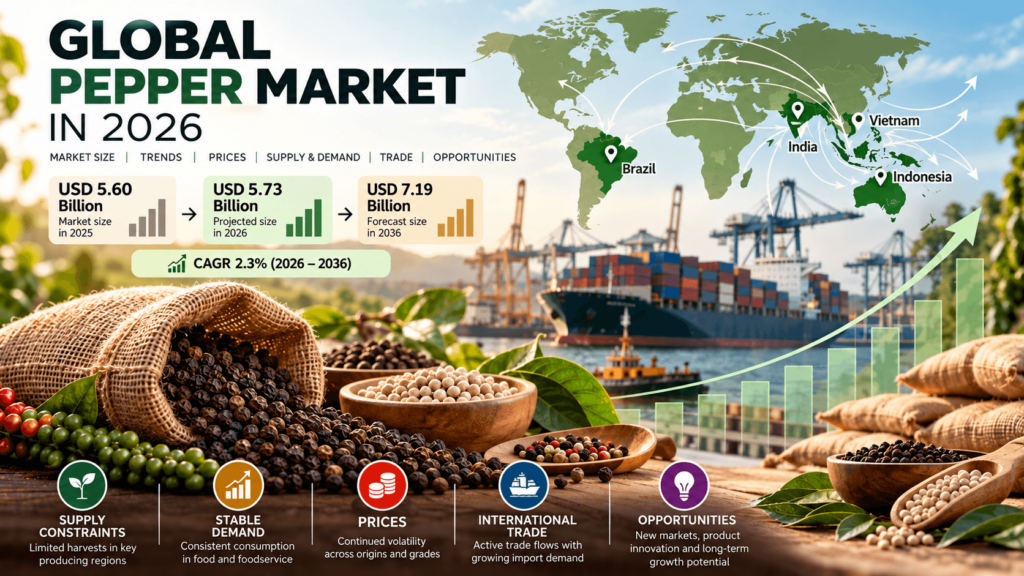
The global pepper market in 2026 continues to be influenced by limited supplies in several major producing countries, stable consumption demand, and rising production and transportation costs. Vietnam, Indonesia, India, and Brazil remain key players in the international pepper trade, significantly influencing global prices and trade flows.
According to Future Market Insights, the global pepper market was valued at approximately USD 5.60 billion in 2025 and is projected to reach USD 5.73 billion in 2026. By 2036, the market could grow to USD 7.19 billion, representing a compound annual growth rate (CAGR) of approximately 2.3%. These figures refer to estimated market size, not total global pepper export value.
Black pepper remains a major product segment because of its widespread use in food processing, restaurants, seasoning production, and the food industry. White pepper also maintains demand in markets where lighter color, distinctive flavor, and specific processing applications are important.
Vietnam continues to play a leading role in international pepper trade. Future Market Insights estimates that Vietnam accounts for approximately 40% of global pepper export volume. This position gives international buyers access to a broad range of products, including black pepper and white pepper, with different specifications and quality grades.
2. Global Pepper Supply, Demand, and Price Trends in 2026
Supply Constraints Continue
Global pepper supplies continue to face several challenges. Production in major growing regions can fluctuate due to weather conditions, crop yields, input costs, and changes in cultivated areas.
The International Pepper Community (IPC) reported that the market in 2025 was structurally tight, with limited carry-over stocks and increasing production, compliance, and logistics costs. Although some producing regions showed signs of recovery, their output was not sufficient to fully offset supply constraints in other major producing countries.
These conditions make it important for buyers to monitor harvest seasons, inventory levels, and production developments in each origin. When supplies decline or available stocks cannot meet demand, pepper prices may increase and delivery lead times may become longer.
Demand Remains Relatively Stable
Pepper is an important ingredient in the food and seasoning industries. Demand comes from packaged food manufacturers, spice processors, restaurants, hotels, and foodservice businesses.
Asia and the Middle East remain important markets because of their established use of spices in food preparation. Demand in other regions also depends on consumer purchasing power, food manufacturing activity, and import requirements.
When pepper prices rise, buyers may adjust order volumes, optimize inventory, or renegotiate contracts. However, because pepper is widely used in many food products, demand does not necessarily decline in direct proportion to price increases.
Pepper Prices Vary by Origin and Quality
In 2026, pepper prices vary according to country of origin, product type, bulk density, cleanliness, and quality specifications. Vietnamese, Indonesian, and Brazilian black pepper may be offered at different prices, while white pepper is priced separately according to its processing requirements and market conditions.
According to IPC price data published on October 16, 2026, indicative prices included:
- Vietnamese black pepper, 500 g/l: approximately USD 5,950 per metric ton.
- Vietnamese black pepper, 550 g/l: approximately USD 5,995 per metric ton.
- Vietnamese white pepper, ASTA specification: approximately USD 8,450 per metric ton.
- Indonesian black pepper: approximately USD 6,769 per metric ton.
- Brazilian black pepper, ASTA 570: approximately USD 5,800 per metric ton.
These figures are indicative prices for a specific date, not fixed transaction prices. Actual quotations may vary depending on product specifications, order volume, shipping terms, transportation costs, and payment conditions.
International Trade Flows and Export Competition
Vietnam, Indonesia, Brazil, and India continue to compete in the international pepper market. Processing capabilities, supply consistency, traceability, and compliance with import standards increasingly influence buyers’ decisions when selecting suppliers.
According to Vietnam News, citing figures from the Vietnam Pepper and Spice Association (VPSA), Vietnam exported approximately 145,700 metric tons of pepper in the first half of 2026, generating export revenue of around USD 940.5 million. Export volume increased by 17.4%, while export value rose by 10.6% compared with the same period in the previous year.
These figures highlight Vietnam’s significant role in global pepper trade. Nevertheless, exporters must continue to manage risks related to raw material price fluctuations, product quality, exchange rates, and delivery schedules.
3. Key Drivers of Pepper Demand
Expansion of the Foodservice Industry
The growth of restaurants, hotels, food delivery services, and food processing industries supports demand for pepper and other spices. Manufacturers often require reliable raw material supplies to maintain consistent flavor across their products and production batches.
Applications of Piperine in Food Processing and Research
Piperine is the compound responsible for the characteristic pungency of black pepper. It has also been studied in food science and pharmaceutical research. Some studies have examined its potential role in influencing the bioavailability of other compounds.
However, specific applications depend on scientific evidence, regulatory requirements, and industry standards. Exporters should avoid making unsupported health claims or statements that are not permitted under applicable regulations.
Quality Standardization by Origin
International buyers increasingly focus on moisture content, bulk density, foreign matter, microbiological quality, pesticide residues, and traceability. These requirements help food manufacturers control raw material quality and reduce risks during importation and processing.
Suppliers that provide clear technical specifications, batch documentation, and relevant test results can gain a competitive advantage in international markets.
4. Challenges Facing the Global Pepper Market
Despite its long-term growth potential, the pepper market faces several challenges.
First, production depends heavily on weather conditions and the growing cycle of pepper plants. Heavy rainfall, drought, and other unfavorable conditions may affect yields and product quality.
Second, rising labor, fertilizer, transportation, and testing costs can increase overall production expenses. Exporters must balance these costs against the prices that international buyers are willing to pay.
Third, price volatility makes long-term contracts more difficult to manage. If market prices increase sharply after a contract price has been agreed upon, sellers may face pressure on their profit margins. Conversely, if prices decline, buyers may find themselves paying more than prevailing market rates.
Finally, food safety, traceability, and residue-control requirements can increase compliance costs, particularly for exporters serving markets with strict import standards.
5. Opportunities in the Global Pepper Market
The 2026 market creates opportunities for exporters that can provide reliable supplies and meet the requirements of different customer segments.
One major opportunity is supplying bulk pepper to importers, spice distributors, and food processing companies. These buyers generally value consistent quality, reliable delivery schedules, and transparent product information.
Exporters can also develop product offerings based on customer requirements, including black pepper, white pepper, and different grades defined by technical specifications. Clear product classification helps buyers select ingredients that suit their processing needs.
There are also opportunities for suppliers to strengthen traceability, improve quality control, and establish long-term relationships with international customers. Rather than competing solely on price, businesses should focus on consistent quality, transparent documentation, and professional export services.
6. Key Trends in the Black Pepper Market
Black pepper remains a major segment of the global pepper market because of its extensive applications in seasonings, packaged foods, processed meat, sauces, and other food products. According to Future Market Insights, black pepper accounts for approximately 46.9% of the pepper market in 2026 under its market classification.
One important trend is the growing emphasis on technical specifications and consistency between shipments. Parameters such as bulk density, moisture content, foreign matter, particle size, and microbiological requirements can directly influence purchasing decisions.
Buyers are also paying greater attention to traceability records, origin information, and relevant test results. For exporters, these requirements create opportunities to build credibility and differentiate their products in international markets.
7. Why Have Pepper Prices Risen Sharply in Recent Years?
Sharp price increases during certain periods have resulted from a combination of factors rather than a single cause.
Changes in Vietnam’s Pepper Production
Vietnam is one of the world’s major pepper-producing and exporting countries. Changes in production, inventory levels, and domestic availability can influence export prices and purchasing decisions among international buyers.
Farmers’ decisions to switch to other crops based on relative profitability may also affect long-term pepper supplies. However, the extent of this impact should be assessed using actual production data for each crop season.
Weather Disruptions in Major Growing Regions
Pepper is a perennial crop that is sensitive to weather conditions and farm management practices. Heavy rainfall, drought, and other unfavorable conditions during the growing cycle can reduce yields or affect harvested quality.
When several major producing regions experience difficulties at the same time, alternative supplies may be limited in the short term, potentially increasing price volatility.
Global Demand and Supply Chain Pressures
Purchasing demand from importers, transportation costs, delivery lead times, and inventory levels all influence pepper prices. When buyers increase their inventories while supplies are limited, competition for available products may intensify.
However, not every price increase should be described as an all-time record. Businesses should compare historical price data by date, origin, and product type before making such claims.
8. Strategic Recommendations for Buyers and Sellers
Plan procurement in advance: Importers should forecast demand, monitor harvest seasons, and consider splitting purchases into several shipments to reduce the risk of buying all their requirements at a single high-price point.
Diversify supply origins: Working with suppliers from multiple countries can reduce dependence on one producing region. However, buyers should evaluate differences in quality, lead times, costs, and import regulations for each origin.
Prioritize quality and consistency: A lower purchase price does not always mean a lower total cost. Products that fail to meet specifications may result in additional testing, processing, re-export, or delivery delays. Buyers should therefore agree on technical specifications and inspection procedures before signing contracts.
Monitor crop and price information: Reports from IPC, VPSA, and other reliable trade sources can help businesses assess supply conditions, export developments, and price trends.
Choose appropriate contract terms: Contracts should clearly define product type, quality parameters, tolerances, packaging, delivery terms, payment methods, and procedures for handling non-conforming goods.
Consider formula adjustments where appropriate: Food manufacturers may review product formulations and spice usage to optimize costs. Any changes should preserve product flavor, quality, and compliance with applicable regulations.
9. Frequently Asked Questions About the Pepper Market in 2026
Which country is the largest pepper exporter in 2026?
Vietnam is widely recognized as one of the world’s leading pepper exporters and a major contributor to global supply. Future Market Insights estimates that Vietnam accounts for approximately 40% of global pepper export volume. The actual share may vary depending on the reporting period and calculation method.
Which type of pepper is exported the most?
Black pepper is widely traded internationally because of its extensive applications in the seasoning and food processing industries. White pepper also serves specific market segments, particularly products requiring a lighter color and a particular flavor profile.
How is the global pepper market performing in 2025–2026?
The market continues to be influenced by limited supplies in some producing regions, higher input costs, and relatively stable consumption demand. Vietnam remains an important player in international trade, while prices vary according to origin, product type, and quality specifications.
What is the export price of black pepper in 2026?
Export prices depend on origin, bulk density, quality specifications, order volume, delivery terms, and quotation date. For example, IPC reported an indicative price of approximately USD 5,950 per metric ton for Vietnamese black pepper, 500 g/l, on October 16, 2026. This is a reference price, not a fixed quotation for every transaction.
Where can exporters find pepper buyers and trade data?
Businesses can consult the International Pepper Community (IPC), the Vietnam Pepper and Spice Association (VPSA), customs authorities, and international trade databases. When identifying potential partners, exporters should verify import capabilities, quality requirements, transaction history, and business credibility.
10. Conclusion
The global pepper market in 2026 continues to be shaped by the balance between supply, demand, and price volatility. Vietnam maintains an important position in international pepper exports, while global buyers increasingly prioritize quality, traceability, and supplier reliability.
For importers and exporters, an effective strategy requires more than monitoring prices. It also involves careful procurement planning, diversified sourcing, quality control, and contract risk management. In a volatile market, transparent business relationships and reliable supply capabilities will remain essential to maintaining long-term competitiveness.
Pepper is an essential product in Vietnam’s spice industry and an important part of TOPAX’s product portfolio. We offer a wide range of pepper products, including Black Pepper 400, 450, 500, 550 G/L FAQ, Black Pepper 500, 550, 570, 600 G/L Spiral Cleaned, Jumbo Black Pepper 570–580 G/L, White Pepper 630 G/L, and Black Pepper Powder. These products serve business customers seeking pepper for wholesale distribution, food manufacturing, and other commercial applications.