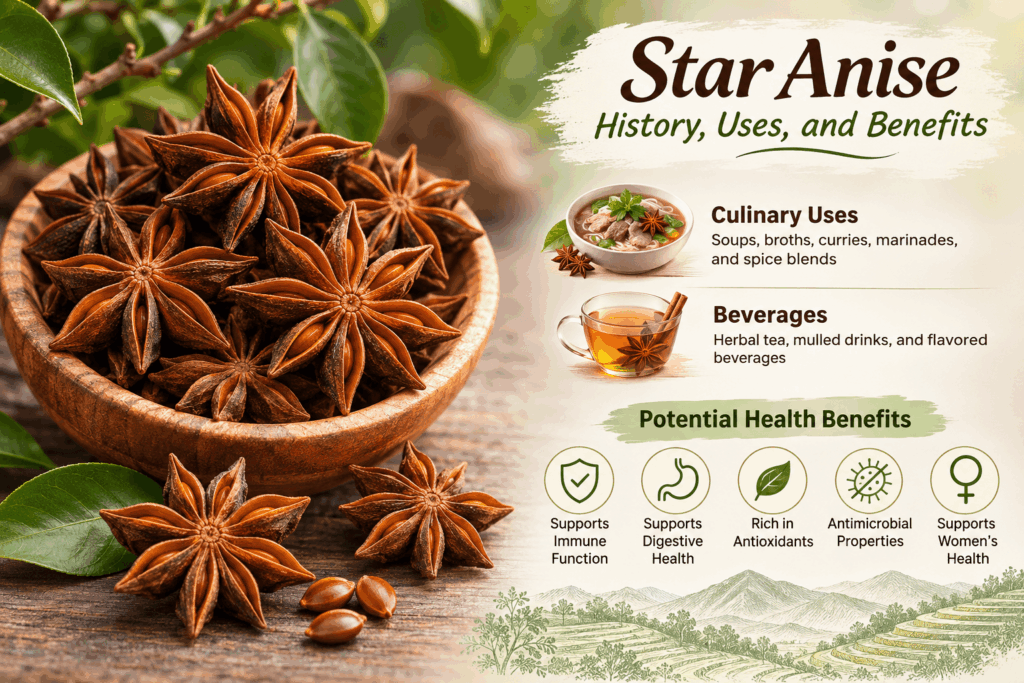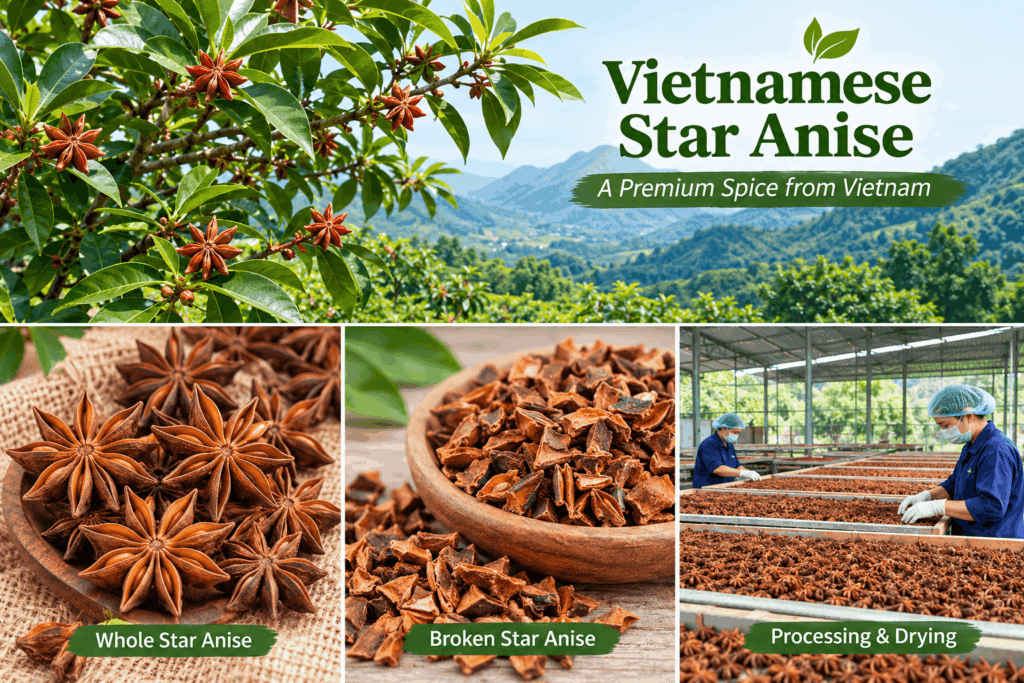

Vietnamese star anise is a distinctive spice valued for its star-shaped appearance, sweet aroma, and characteristic licorice-like flavor. Its main culinary applications include seasoning blends, soups, sauces, meat products, beverages, and food processing. Star anise is also traded as a raw botanical ingredient for various industrial applications, subject to the relevant product specifications and regulations.
Vietnam is an important origin for star anise, particularly in the northern mountainous regions, where Lang Son is well known for its cultivation. With its distinctive appearance and aromatic properties, Vietnamese star anise serves a range of international markets, including spice importers, wholesalers, distributors, and food manufacturers.
As a Vietnamese spice supplier focused on international trade, TOPAX includes star anise among its key export products. Supplying overseas buyers involves more than sourcing the spice: it requires careful product selection, processing, quality control, appropriate packaging, export documentation, and coordinated international logistics.
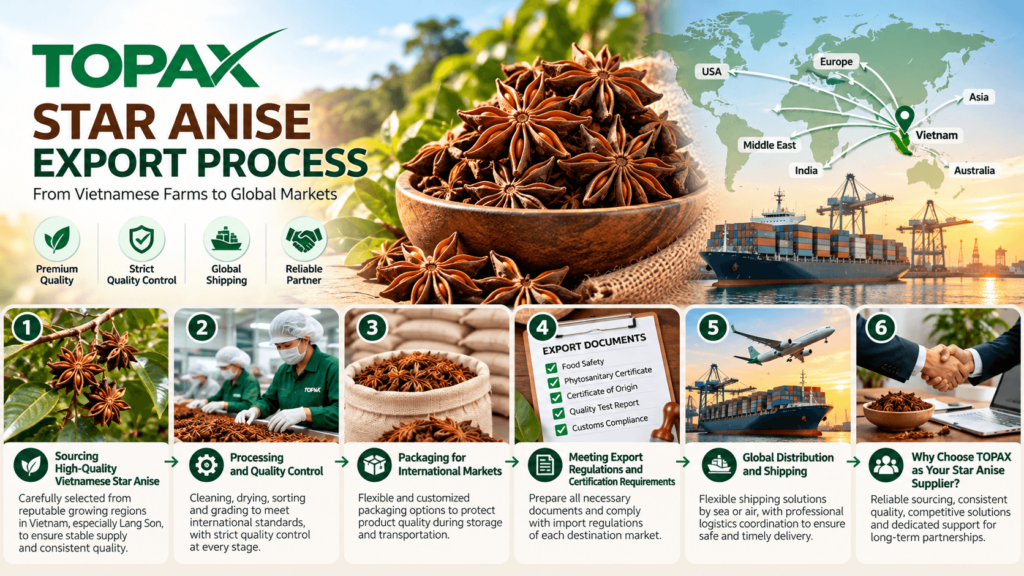
This article explains the key stages of the star anise export process at TOPAX, from sourcing Vietnamese star anise to preparing shipments for international customers.
1. Sourcing High-Quality Vietnamese Star Anise
The quality of an export shipment begins with the selection of suitable raw materials. Star anise can vary in appearance, aroma, moisture content, maturity, and the proportion of whole or broken fruits. These characteristics influence its suitability for different applications and buyer requirements.
Sourcing from Established Growing Regions
Vietnamese star anise is cultivated mainly in northern mountainous areas, with Lang Son being one of the best-known growing regions. Sourcing from suitable growing areas helps exporters identify products with characteristics that meet the intended market and product specifications.
When evaluating potential supplies, relevant considerations include product origin, harvest condition, appearance, aroma, and the availability of supporting information about the raw material.
Selecting Star Anise According to Product Specifications
Different customers require different grades of star anise. Some prefer whole, well-formed star-shaped fruits for retail packaging and premium spice products, while others purchase broken star anise for grinding, extraction, or industrial processing.
Depending on the buyer’s requirements, the main commercial forms may include:
- Whole Star Anise: Whole, star-shaped fruits selected for applications where appearance and product integrity are important.
- Broken Star Anise: Broken or fragmented fruits suitable for applications where whole-star appearance is less important.
- Customized Grades: Products prepared according to agreed requirements for size, appearance, cleanliness, moisture, and other relevant quality parameters.
Product names and grades should be confirmed in the sales specification to ensure that the buyer and supplier have the same understanding of the expected product.
Evaluating Raw Material Quality
Before processing and packing, raw materials should be evaluated against the agreed product specifications. Depending on the product and destination market, this may include checking:
- Appearance, color, and characteristic aroma.
- Proportion of whole and broken fruits.
- Moisture content.
- Foreign matter and visible defects.
- Signs of mold, insect damage, or unsuitable storage conditions.
- Applicable food safety and laboratory testing requirements.
The inspection criteria should be defined according to the intended use and the buyer’s requirements. Where testing is necessary, representative samples should be assessed using suitable methods.
2. Processing and Quality Control
Processing plays an important role in maintaining the appearance, aroma, and suitability of star anise for export. The exact processing steps depend on the condition of the raw material, the required product grade, and the agreed specifications.
Cleaning and Sorting
Cleaning and sorting help remove unwanted foreign matter and separate star anise according to its physical condition and commercial grade.
Depending on the production setup, sorting may involve manual inspection, screening, or suitable equipment. The objective is to prepare a more consistent product that meets the buyer’s requirements.
Drying and Moisture Management
Moisture management is important for preserving dried star anise during storage and transportation. Excessive moisture can increase the risk of mold growth, deterioration, and loss of product quality.
The moisture level should be controlled according to the product specification and the applicable requirements of the destination market. Drying conditions should also be managed carefully to preserve the spice’s characteristic aroma and appearance.
Grading and Removal of Defects
After cleaning and drying, star anise may be sorted by size, appearance, and the proportion of whole or broken fruits. Visible defects and unsuitable material should be removed according to the agreed acceptance criteria.
Consistent grading helps buyers receive products that are better suited to their intended applications, whether for retail spice packaging, food manufacturing, or further processing.
Food Safety and Laboratory Testing
Depending on the destination market, buyer requirements, and intended application, quality assurance may include laboratory testing for relevant parameters such as:
- Moisture content.
- Microbiological criteria.
- Pesticide residues.
- Heavy metals or other contaminants where required.
- Other product-specific parameters agreed with the buyer.
Testing should be conducted by a suitable laboratory using appropriate methods. Any claims regarding compliance should be supported by relevant test results or documentation.
Batch Identification and Traceability
Traceability helps connect a shipment with its product specification, sourcing information, processing records, inspection results, and packaging details.
A clear batch identification system can support quality investigations, document verification, and communication between the exporter, importer, and other parties in the supply chain. The exact records maintained depend on the product, applicable requirements, and the parties involved.
3. Packaging for International Markets
Packaging protects star anise during storage, handling, and international transportation. It should help maintain product condition, prevent contamination, and meet the buyer’s requirements for shipment, warehousing, and distribution.
Choosing Suitable Packaging Materials
Packaging depends on the product form, shipment size, storage conditions, transportation method, and destination market.
For bulk star anise, packaging options may include suitable food-grade inner liners and woven or other appropriate outer bags. Cartons or other packaging formats may be considered when required by the buyer or the intended distribution channel.
The packaging material should be suitable for contact with the product where applicable, clean, and capable of protecting the spice under expected handling and transportation conditions.
Customized Packaging for B2B Buyers
Different importers and distributors may have their own packaging requirements. TOPAX can discuss packaging specifications with buyers during the quotation and order-confirmation stages.
Depending on feasibility and the agreed order terms, packaging details may include:
- Net weight per bag or package.
- Inner liner and outer packaging materials.
- Bag dimensions and packaging format.
- Product identification and batch coding.
- Label language and required product information.
- Shipping marks and handling instructions.
All packaging details should be confirmed before production or packing begins to reduce the risk of discrepancies between the order and the final shipment.
Product Labeling and Shipping Marks
Labels and shipping marks help identify the product and facilitate handling throughout the supply chain. Depending on the destination and the type of sale, required information may include the product name, net weight, country of origin, batch or lot number, exporter details, and other legally required information.
The final labeling format should be checked against the import requirements of the destination market. Buyers should provide any mandatory language, label layout, or importer-specific requirements early in the order process.
4. Meeting Export Regulations and Certification Requirements
Exporting star anise requires attention to both Vietnamese export procedures and the regulations of the destination country. Requirements vary depending on the product, its intended use, the importing market, and the terms of the transaction.
Food Safety Compliance
Star anise intended for food use should meet applicable food safety requirements in Vietnam and the destination market. Depending on the transaction, the buyer may request product specifications, laboratory reports, food safety documentation, or information about the handling and processing system.
The applicable requirements should be confirmed before the order is finalized, especially when supplying markets with specific limits for contaminants, pesticide residues, or microbiological parameters.
Export Documentation
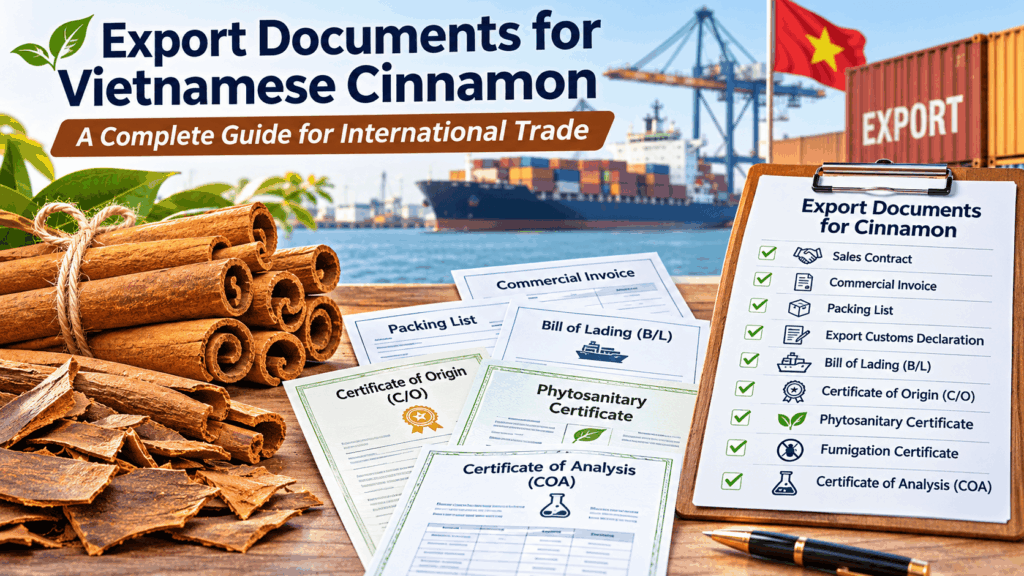
Export documentation depends on the shipment, destination, and contract. Documents commonly involved in international trade may include:
- Commercial Invoice.
- Packing List.
- Bill of Lading or Air Waybill.
- Certificate of Origin, where applicable and requested.
- Phytosanitary Certificate, where required by the destination country’s plant health rules.
- Relevant food safety, health, inspection, or laboratory documents, where required.
Not every shipment requires every document listed above. The exact documentation should be confirmed with the importer, freight forwarder, customs broker, and relevant authorities before shipment.
Phytosanitary Requirements
Some importing countries require a phytosanitary certificate for specified plant products to address plant pest risks. Whether a certificate is necessary for a particular star anise shipment depends on the destination country’s regulations, the product’s status, and the applicable import conditions.
The requirement should be verified before dispatch. International plant health standards provide a framework for phytosanitary certification, but they do not mean that every dried spice shipment automatically requires the same certificate.
Origin and Certification Documentation
A Certificate of Origin may be required by the buyer or used to support preferential tariff treatment when the shipment meets the relevant rules of origin and trade agreement requirements.
Other documents, such as health certificates or certificates related to food safety systems, may be requested by certain markets or customers. Such documents should only be represented as available when the shipment or relevant establishment meets the applicable conditions and the document has been properly issued.
For this reason, TOPAX and its customers should confirm documentation requirements before finalizing the export arrangement.
5. Global Distribution and International Shipping
After product preparation, quality checks, packaging, and documentation are completed, the shipment can be coordinated for international delivery. Effective logistics planning helps protect product quality and supports reliable order fulfillment.
Selecting the Appropriate Shipping Method
Sea freight is commonly considered for large-volume spice shipments because it can be suitable for bulk commercial orders. Air freight may be considered for smaller shipments or orders where shorter transit times are important.
The appropriate method depends on shipment volume, destination, delivery schedule, budget, and the buyer’s requirements.
Container Loading and Cargo Protection
Before loading, packaging and cargo should be checked for visible damage, cleanliness, and suitability for transportation. The container should be suitable for the cargo, clean, dry, and free from conditions that could compromise the quality of dried spices.
Proper loading and securing help reduce movement and physical damage during transit. Moisture exposure and condensation should also be considered when planning container transport and cargo protection.
Freight Coordination and Delivery Terms
International shipments require coordination among the exporter, importer, freight forwarder, carrier, and customs representatives as applicable.
The sales contract should clearly define the agreed Incoterms® rule, named place or port, responsibilities for freight and insurance, and the point at which risk transfers from seller to buyer. These details help both parties understand their respective obligations.
Shipment Tracking and Communication
Clear communication helps buyers plan customs clearance, warehouse receiving, and onward distribution. Important updates may include cargo readiness, booking confirmation, estimated departure, shipping document status, and estimated arrival.
Actual transit times depend on the route, carrier schedule, port conditions, customs procedures, and other operational factors. Delivery schedules should therefore be confirmed for each shipment rather than assumed to be identical across destinations.
6. Why Choose TOPAX as Your Star Anise Supplier?
Choosing a suitable star anise supplier involves more than comparing prices. International buyers need a supplier that understands product specifications, communicates clearly, and can coordinate sourcing, quality requirements, packaging, documentation, and shipping.
Vietnamese Star Anise Sourcing
Vietnam is an established origin for star anise, with Lang Son recognized as an important growing region. Working with a supplier familiar with Vietnamese spice sourcing can help buyers explore product options and define requirements according to their intended applications.
TOPAX works with buyers to discuss the required product form, quality parameters, packaging, and order conditions before confirming a shipment.
Product Options for Different Applications
Whole star anise and broken star anise serve different commercial needs. Whole fruits may be preferred where appearance matters, while broken material may suit certain processing applications.
TOPAX can discuss the requested grade and specifications with prospective buyers to determine a suitable product option, subject to availability and order confirmation.
Quality Specifications and Documentation
Clear specifications help align expectations between the buyer and supplier. Relevant parameters may include appearance, moisture, foreign matter, packaging, and testing requirements.
Documentation should correspond to the actual product and shipment. Where testing or certificates are required, the applicable scope, issuing body, and validity should be confirmed before making compliance claims.
Flexible Packaging and Export Coordination
Packaging requirements differ among importers, distributors, and food manufacturers. Discussing packaging formats, weights, labeling, shipping marks, and delivery terms in advance helps reduce avoidable changes during order preparation.
TOPAX aims to coordinate these requirements with buyers before shipment so that product preparation and export arrangements are aligned with the agreed order.
Communication for International Buyers
A reliable export process depends on clear communication at every stage, from initial inquiry and quotation to specification approval, shipment preparation, and document coordination.
By confirming product requirements and commercial terms in advance, buyers and suppliers can reduce misunderstandings and manage orders more efficiently.
7. Start Your Vietnamese Star Anise Sourcing with TOPAX
Selecting the right Vietnamese star anise supplier starts with clearly defining your product requirements, target market, and expected shipment volume.
Whether you are sourcing whole star anise for spice distribution or broken star anise for food processing, TOPAX welcomes inquiries from importers, wholesalers, distributors, and food manufacturers interested in Vietnamese spices.
Contact TOPAX to discuss your required product form, quality specifications, packaging preferences, destination market, and shipment volume. Our team can review your requirements and discuss the next steps for a potential export order.