
Cinnamon is a widely used spice obtained from the inner bark of trees belonging to the Cinnamomum genus. It is valued for its distinctive aroma, warm flavor, and versatility in food and beverage production. Cinnamon is used in baked goods, desserts, beverages, spice blends, sauces, and various traditional preparations. It is also traded internationally in several forms, including cinnamon sticks, broken bark, chips, and powder.
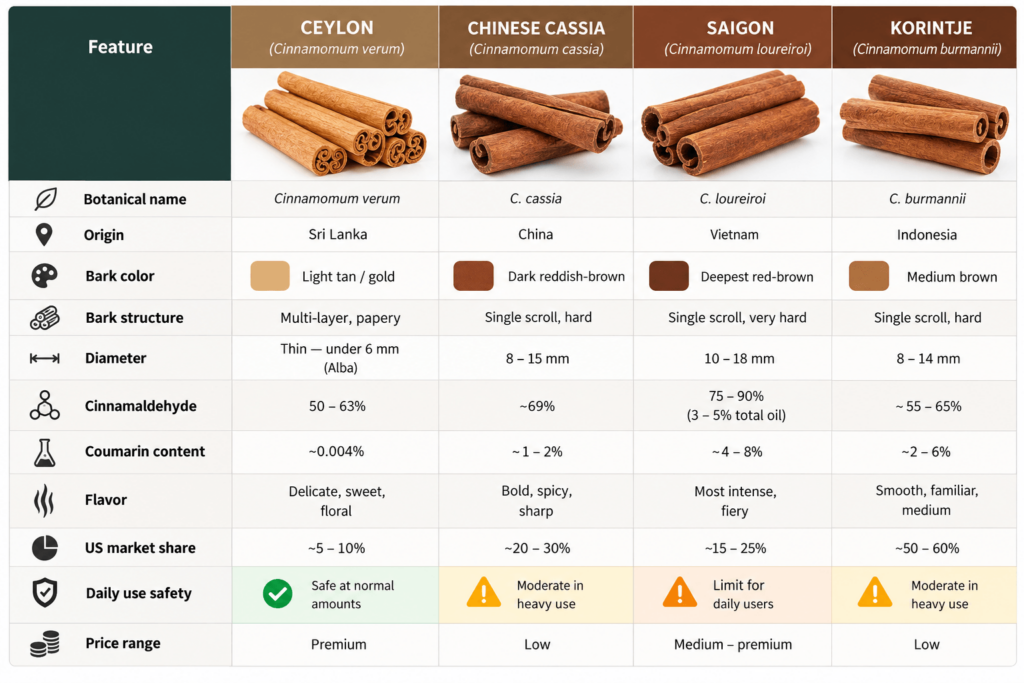
Although cinnamon products may look similar, different species can vary considerably in bark structure, texture, flavor intensity, chemical composition, and culinary applications. Four commercially important types are Ceylon cinnamon, Chinese cinnamon, Saigon cinnamon, and Korintje cinnamon. Ceylon cinnamon is commonly associated with Cinnamomum verum, while the other three belong to different cassia species.
Understanding these differences helps consumers, food manufacturers, importers, and spice distributors select the right cinnamon for their products and markets.
1. Ceylon Cinnamon (Cinnamomum verum)
Origin
Ceylon cinnamon, often called “true cinnamon,” originates from Sri Lanka, historically known as Ceylon. It has a long history of cultivation and international trade and is recognized for its delicate flavor and distinctive bark structure.
Bark Appearance
Ceylon cinnamon bark is generally light brown to tan. Its thin inner bark is carefully processed into multiple delicate layers, creating the characteristic appearance of a tightly rolled cinnamon stick.
Texture
Ceylon cinnamon has a thin, fragile, and relatively soft texture. Its quills typically consist of several thin layers rolled together, making them easier to break or grind than the thicker bark of many cassia varieties.
Flavor
Ceylon cinnamon has a mild, delicate, and slightly sweet flavor with subtle citrus and floral notes. Its aroma is generally less intense and less pungent than that of cassia cinnamon, making it suitable for recipes that require a refined cinnamon profile.
Coumarin Content
Ceylon cinnamon generally contains very low levels of coumarin compared with cassia varieties. Coumarin is a naturally occurring compound that can be present in relatively high concentrations in cassia cinnamon. However, the actual content varies by sample and should be verified through appropriate testing when required.
For consumers who regularly use cinnamon in larger quantities, Ceylon cinnamon may be a preferable option because of its typically low coumarin content. This does not mean that every cinnamon product has the same composition or that large supplemental doses are automatically safe.
Growing Regions
Sri Lanka is the principal origin associated with Ceylon cinnamon. The species is also cultivated in other tropical regions with suitable growing conditions, including parts of southern India and other areas where cinnamon production is established.
Uses
Ceylon cinnamon is commonly used in premium spice products, baked goods, desserts, beverages, breakfast foods, and specialty seasoning blends. Its delicate aroma makes it suitable for recipes where a subtle cinnamon flavor is preferred over a strong, pungent taste.
It is also used in whole-stick and ground forms for retail products and food manufacturing. Buyers should specify the required botanical species when sourcing Ceylon cinnamon to distinguish it from cassia products.
2. Chinese Cinnamon (Cinnamomum cassia)
Origin
Chinese cinnamon, commonly known as Chinese cassia, comes from Cinnamomum cassia. It has traditionally been associated with China and has a long history of use in culinary and traditional preparations.
The name “cassia” is also used commercially for several related cinnamon species. Therefore, the term alone does not always identify the exact botanical origin of a product.
Bark Appearance
Chinese cassia bark is generally reddish-brown to dark brown. Compared with Ceylon cinnamon, the bark is usually thicker, harder, and less delicate. Dried bark may be sold as whole quills, pieces, or ground cinnamon.
Texture
Chinese cassia typically has a firm, woody texture. Its thicker bark often forms a relatively simple roll rather than the many thin, tightly packed layers characteristic of Ceylon cinnamon.
Flavor
Chinese cassia has a strong, warm, sweet-spicy flavor with noticeable pungency. Its more robust profile makes it suitable for products that require a pronounced cinnamon taste.
Flavor intensity can vary according to the growing region, harvest conditions, bark quality, and processing method.
Coumarin Content
Chinese cassia generally contains more coumarin than Ceylon cinnamon. However, coumarin levels are not identical across all cassia products. They can vary with the species, sample, growing conditions, and processing.
For products intended for frequent consumption or markets with specific safety requirements, buyers should review relevant regulatory requirements and request laboratory testing where appropriate.
Growing Regions
China is the traditional origin of Chinese cassia. Related cassia species are also cultivated in other parts of Asia, although products from different species should not automatically be classified as Chinese cassia.
Clear origin and botanical identification are important for international trade, particularly when buyers require a specific flavor profile or product specification.
Uses
Chinese cassia is used in cooking, spice blends, baked goods, beverages, sauces, and processed foods. Its strong flavor makes it suitable for recipes that require a pronounced cinnamon character.
It is also used in ground form and as dried bark for food manufacturing and seasoning applications. Commercial buyers should define the desired flavor intensity, bark form, and quality parameters before placing bulk orders.
3. Saigon Cinnamon (Cinnamomum loureiroi)
Origin
Saigon cinnamon is obtained from Cinnamomum loureiroi, a cassia species strongly associated with Vietnam. It is known in international trade for its intense aroma, pronounced flavor, and use in applications requiring a strong cinnamon profile.
The commercial name “Saigon cinnamon” does not mean that all products are necessarily grown in Ho Chi Minh City. Botanical identity and actual growing origin should be confirmed through supplier documentation.
Bark Appearance
Saigon cinnamon bark is typically reddish-brown to dark brown. The bark is generally thicker and more robust than Ceylon cinnamon bark, and its appearance can vary according to bark maturity, processing, and product grade.
Commercial products may include whole cinnamon sticks, split bark, broken cinnamon, and other cut forms.
Texture
Saigon cinnamon generally has a firm, relatively thick, and woody texture. Its bark is suitable for processing into whole sticks, split pieces, broken bark, and powder, depending on the customer’s specifications.
The exact thickness, dimensions, and appearance vary by grade and processing requirements.
Flavor
Saigon cinnamon is known for its strong, warm, sweet-spicy flavor and intense aroma. It is often perceived as more pungent than Ceylon cinnamon and can deliver a pronounced cinnamon character in food products.
Its strong flavor profile makes it attractive to food manufacturers and spice buyers who require an ingredient that remains noticeable in baked goods, beverages, and seasoning blends.
Coumarin Content
Saigon cinnamon generally contains higher levels of coumarin than Ceylon cinnamon. Research examining authenticated cinnamon samples has also found substantial coumarin levels in Cinnamomum loureiroi. Nevertheless, the concentration can vary between samples, so a single value should not be assumed for every shipment.
Businesses selling cinnamon into regulated markets should evaluate applicable requirements and use laboratory results when a specific coumarin limit or declaration is required.
Growing Regions
Vietnam is the principal origin associated with Saigon cinnamon. Cinnamon is cultivated in several Vietnamese growing areas, particularly in regions with suitable tropical and subtropical conditions.
Vietnam’s established cinnamon supply chain supports the availability of different commercial forms for domestic processing and international trade. Actual origin and specifications should be confirmed for each product.
Uses
Saigon cinnamon is widely used in baked goods, cinnamon rolls, biscuits, desserts, beverages, sauces, and spice blends. Its strong aroma and flavor make it suitable for recipes where cinnamon is intended to be a prominent ingredient.
For B2B buyers, available product forms may include cinnamon sticks, split cinnamon, broken cinnamon, and cinnamon powder. Specifications such as moisture content, dimensions, cleanliness, packaging, and other quality parameters should be agreed upon before shipment.
4. Korintje Cinnamon (Cinnamomum burmannii)
Origin
Korintje cinnamon is a commercial type of cassia cinnamon associated primarily with Indonesia. It is obtained from Cinnamomum burmannii and is widely traded for use in food manufacturing and the spice industry.
The name “Korintje” is commonly associated with Indonesian cassia products and is used in international trade to distinguish this cinnamon from other commercial types.
Bark Appearance
Korintje cinnamon bark is generally medium to dark brown, although its color varies according to the grade and processing method. The bark is typically thicker and more rigid than Ceylon cinnamon bark.
It is commercially available in different forms, including sticks, broken bark, chips, and powder.
Texture
Korintje cinnamon usually has a firm, woody texture typical of cassia cinnamon. Its bark can be processed into whole or cut products, while lower-grade or broken material may be used for grinding and further processing.
The physical characteristics of a shipment depend on the selected grade, processing method, and buyer specifications.
Flavor
Korintje cinnamon has a warm, sweet, woody flavor with moderate to strong intensity. Its flavor profile makes it a popular ingredient in bakery products, spice blends, and commercially manufactured foods.
The perceived strength of its aroma and flavor varies by product grade, freshness, storage conditions, and the formulation in which it is used.
Coumarin Content
Korintje cinnamon generally contains more coumarin than Ceylon cinnamon. A published study analyzing authenticated cinnamon samples found substantial coumarin levels in Cinnamomum burmannii. However, the actual content can vary considerably between products.
Where coumarin content is important for consumer safety, product labeling, or regulatory compliance, buyers should request suitable laboratory analysis rather than relying solely on the commercial name or country of origin.
Growing Regions
Indonesia is the primary origin associated with Korintje cinnamon. The country’s cinnamon-growing areas supply domestic processors and international buyers, with product availability depending on harvests, processing capacity, and market demand.
When purchasing Korintje cinnamon, importers should confirm the botanical species and origin to ensure the product matches their requirements.
Uses
Korintje cinnamon is widely used in bakery products, cinnamon rolls, cookies, cakes, desserts, breakfast foods, and commercial spice blends. Its balanced sweet-spicy profile makes it suitable for large-scale food manufacturing.
It is traded in whole and processed forms, allowing buyers to select products according to their production processes. For bulk orders, specifications should cover product form, grade, moisture, foreign matter, packaging, and any required food safety or testing documentation.
5. Frequently Asked Questions About Cinnamon
What Are the Four Main Types of Cinnamon?
Four commercially important types are Ceylon cinnamon (Cinnamomum verum), Chinese cinnamon (Cinnamomum cassia), Saigon cinnamon (Cinnamomum loureiroi), and Korintje cinnamon (Cinnamomum burmannii).
They differ in botanical species, growing origin, bark structure, flavor intensity, and chemical composition. These differences influence their suitability for retail products, food manufacturing, baking, beverages, and spice blends.
What Is Saigon Cinnamon, and Is It Good for Your Health?
Saigon cinnamon is a cassia cinnamon obtained from Cinnamomum loureiroi and associated primarily with Vietnam. It is known for its intense aroma and strong, sweet-spicy flavor.
Cinnamon is commonly used as a food ingredient, but its effects on health depend on the type consumed, the amount, and individual circumstances. Saigon cinnamon generally contains more coumarin than Ceylon cinnamon. Consuming large amounts of cassia cinnamon over long periods may be a concern for people sensitive to coumarin, particularly those with liver-related conditions. Cinnamon should not be considered a substitute for medical treatment.
Is Saigon Cinnamon the Same as Ceylon Cinnamon?
No. Saigon cinnamon and Ceylon cinnamon are different botanical species.
Saigon cinnamon is Cinnamomum loureiroi, a cassia type associated primarily with Vietnam. Ceylon cinnamon is Cinnamomum verum, commonly associated with Sri Lanka.
Saigon cinnamon generally has a stronger, more pungent flavor and higher coumarin levels. Ceylon cinnamon has a milder flavor, a delicate layered bark structure, and typically very low coumarin levels.
What Is Korintje Cinnamon?
Korintje cinnamon is a commercial type of cassia cinnamon obtained from Cinnamomum burmannii and associated primarily with Indonesia. It has a warm, sweet, woody flavor and is widely used in bakery products, cinnamon rolls, cookies, desserts, and commercial spice blends.
It is available in various product forms, including sticks, broken bark, chips, and powder. Buyers should confirm the botanical identity, origin, grade, and technical specifications when sourcing it in bulk.
Which Type of Cinnamon Is the Healthiest?
There is no single type of cinnamon that is best for everyone. For people who regularly consume cinnamon, Ceylon cinnamon is often preferred because it generally contains much less coumarin than cassia varieties.
However, health outcomes depend on the amount consumed, individual health conditions, and the form of the product. Evidence does not support treating cinnamon as a replacement for prescribed medication. People who have liver disease, take medication, or plan to consume cinnamon supplements regularly should consult a qualified healthcare professional.
Which Type of Cinnamon Is Best for Cinnamon Rolls?
The best type depends on the flavor profile you want.
Saigon cinnamon is a good choice when a strong, intense cinnamon flavor is desired. Korintje cinnamon is also popular in commercial baking because of its warm, sweet, woody flavor. Ceylon cinnamon may suit recipes that call for a more delicate and subtle aroma.
For commercial bakeries, the final choice should be based on flavor testing, recipe requirements, consistency between batches, ingredient costs, and any applicable food safety specifications.
Does the Type of Cinnamon You Use Matter?
Yes. Different cinnamon species can vary in flavor, aroma, bark structure, chemical composition, and coumarin content. These differences can affect the taste of a finished product, its ingredient specifications, and its suitability for particular applications.
For home cooking, the choice may depend mainly on personal preference. For food manufacturers, importers, and spice distributors, botanical identity, origin, quality grade, product consistency, and regulatory compliance are important purchasing considerations.
Conclusion
The four major commercial types of cinnamon—Ceylon, Chinese cassia, Saigon, and Korintje—each offer distinctive characteristics and applications. Ceylon cinnamon is known for its delicate flavor and low coumarin content, while the three cassia types are generally recognized for their stronger flavor profiles and thicker bark.
For international buyers, selecting the right cinnamon requires more than comparing names or prices. Understanding the botanical species, origin, physical characteristics, flavor profile, and quality specifications helps businesses source products that meet their intended applications.
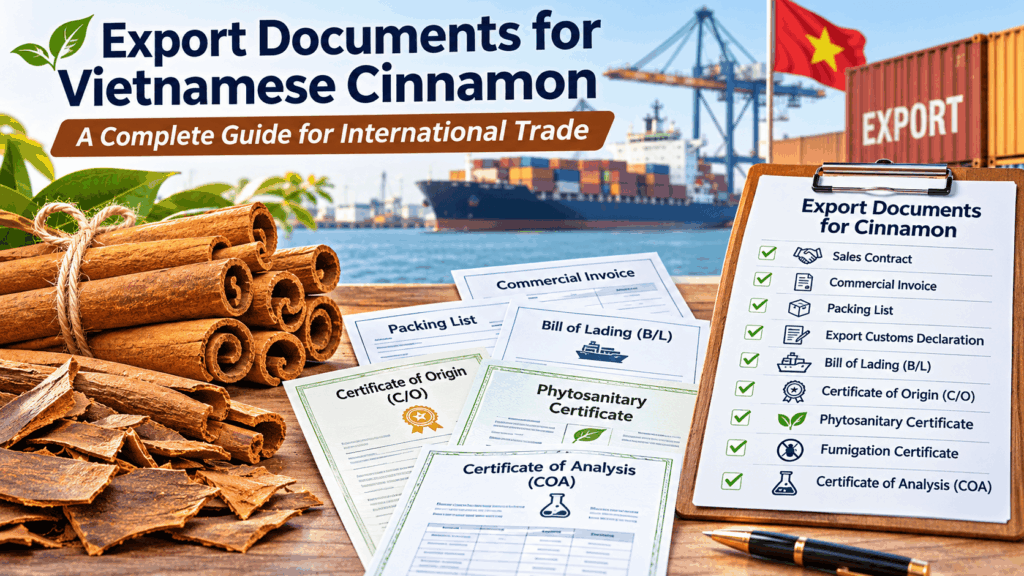
When purchasing cinnamon for commercial use, buyers should confirm product identity, agree on technical specifications, and request relevant quality documentation. These steps help support product consistency, regulatory compliance, and reliable long-term sourcing.
Vietnamese Cinnamon, commonly traded internationally as Cassia, is an important product in our portfolio. TOPAX offers a wide range of cinnamon products, including Stick Cinnamon, Cigarette Cinnamon, Split Cinnamon, Broken Cinnamon, Whole Tube Cinnamon, Pressed Cinnamon, Round Cut Cinnamon, Square Cut Cinnamon, and Cinnamon Powder for commercial applications. Product forms, grades, and specifications are agreed upon according to each customer’s specific requirements.